
One Therapist’s Experience Living With Type 1 Diabetes

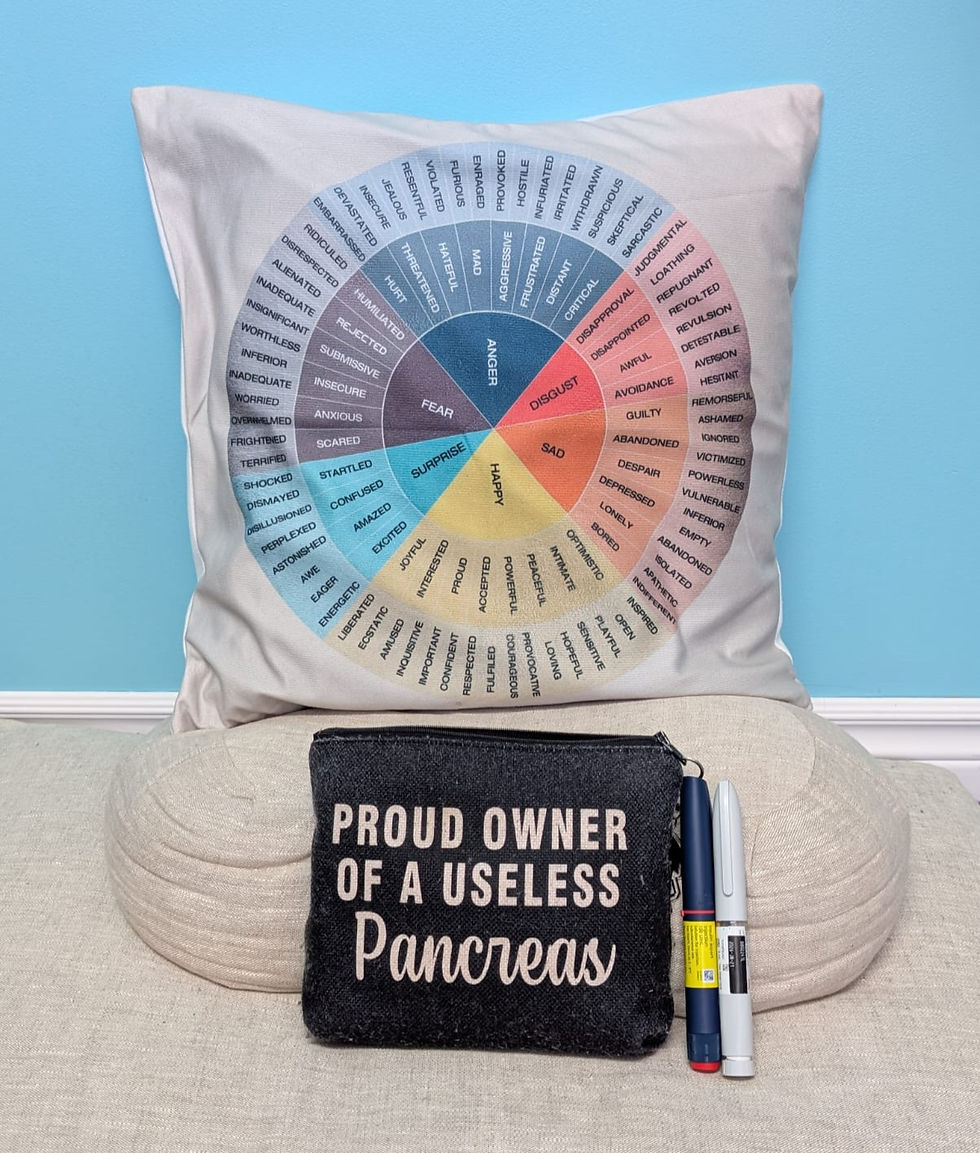
Hey everyone! This is my first blog post for Within The Seasons, and I want to thank you all for being here!
My name is Allison Oke, my pronouns are she/her, and I am a therapist with Type 1 Diabetes.
I’ve been in the helping profession since I was 23 years old. I started my career as a bedside Registered Nurse, and now I’m also a Psychotherapist with Seasons. How long have I been a type 1 diabetic? 32 years! Much longer than my career in the helping professions, and unfortunately I cannot retire anytime soon from my diabetes.
This leads me into my post, describing my experience being a type 1 diabetic and the unique challenges and reflections I experience from living with this illness as a human, a nurse, and a psychotherapist.
What Is Type 1 Diabetes?
Some may be confused with the different types of diabetes, and it’s understandable. There’s type 1, type 2, gestational, prediabetes, and adult onset type 1 diabetes. That’s a lot of different versions! For the sake of this blog post, I will only cover type 1. But I encourage you to become informed of the different types of diabetes to understand how each is managed. One site I’ll suggest to reference is Diabetes Canada at diabetes.ca.
I digress.
Type 1 diabetes is also known as juvenile diabetes, where a young child’s pancreas will suddenly stop producing their own insulin. All of our organs have a unique function in our body, and the pancreas is responsible for making digestive enzymes and islet cells, or insulin, to help maintain balance in digestion and blood sugar levels in the body. How diabetes can develop and the chemistry involved can be complex to explain, so I’ll leave it short. But the point is, when the pancreas no longer produces insulin, the breakdown of sugar and carbohydrates from our food will over capacitate the body. This can cause someone to be fatally ill if not treated properly. Thankfully, people with type 1 diabetes can take insulin through injections to replace what the pancreas no longer produces. Unfortunately, type 1 diabetes is a chronic illness with no cure. For me, my diabetes developed at 4 years old, and I have been on insulin injections since then!
What Is It Like Living with Type 1 Diabetes?
Challenging.
Manageable!
But challenging.
The amount of insulin that I have to take depends on what I eat, drink, how much I am exercising, and what my work day looks like. And throughout my lifespan, I have gone through so many changes, thus my insulin dose changes. It becomes an ever changing equation with no perfect formula. And getting the wrong dose of insulin has its own consequences, low and high blood sugars, both of which make me feel sick. Our lives go through different stages, experiences and challenges. Having type 1 diabetes means that it stays with me through all of these things, and it becomes something that I have to micromanage. So when you have to be active with the treatment of an illness 24/7, it can become a recipe for burnout. Because no matter if I am grieving the death of a family member or friend, working, going for a walk, or going on a trip with my family, I can not turn off my diabetes. I can not take a break from my diabetes. And if I forget to take my insulin or check my sugars (it happens!) then there are consequences. I can not step away or take a break from it. So I think, if I was to name the biggest challenge of having type 1 diabetes it would be this.
One experience that has challenged me many times: waking up at 2am with low blood sugars. I wake up with my heart racing, sweating, shaky, and the occasional headache and disorientation. The brain needs sugar to function after all! So I wake up, have apple juice, and wait for my sugars to correct. This takes a minimum of 20 minutes. Diabetic comas do happen, so I stay awake and have another juice if my sugars do not correct themselves. Then I wake up again at 6am to get ready for work like nothing happened. This can be really challenging when you feel like you are only functioning on half a cup. But if I had to call in sick every time I was up during the night due to a low blood sugar, sometimes high blood sugars too - then my worklife would be compromised.
So Now Let’s Talk About The Spoon Metaphor.
The spoon metaphor is something I love bringing into counselling sessions with my clients to help understand how much energy is spent in the run of a day. It’s also a great way to understand and be more compassionate towards ourselves when we are feeling exhausted and don’t know why.
Now imagine you wake up in the morning with 20 spoons. Or maybe you prefer percentages, so you wake up with 100% of your spoons for your day. One task takes 1 spoon. Sometimes one task can take more than one spoon depending on how much energy it takes! For my type 1 diabetes: I use 1 spoon each time I take my insulin, so about 5 spoons. Then I use 1 spoon every time I check my blood sugars, which is at least 5 spoons. I’ve already used up half of my spoons. And if I am having a day where my blood sugars are all over the place, then I use up 2 spoons for each task because I feel fatigued and sometimes unwell. There are many days where I am in a deficit of spoons. Having type 1 diabetes is a full time job. And I want to let my readers know that if you have diabetes or a chronic illness that takes up a lot of spoons…I hear you.
Learning to balance control, power, and choice has been something that I’ve reflected on numerous times over these last 32 years with an illness that was beyond my choice. Type 1 diabetes will have the final say, but not in everything. What are the parts of my life that diabetes has control over? What parts of my life do I have control over? And what are the parts that are beyond my control? This is important to reflect on, as our lives are impacted by forces outside of ourselves.
For example, I can choose how to approach my client when my blood sugars go low during a session. While I do my best to maintain control over my blood sugars, as I’ve mentioned, it is not always a perfect science. It is my choice how I bring this up with a client. I kindly tell them that I have to drink juice because I have diabetes. But do I allow my low blood sugar to have power over the rest of the session? No. Oftentimes, clients become curious and this allows deeper therapeutic discussions. Alas, there was a point in my life that I would not address what was happening to me and pretend that I wasn’t having low blood sugar to maintain “normalcy." Almost like, “there is nothing to see here!” But I learned to be open and name how I was feeling.
How?
The majority of people to whom I've disclosed that I needed to take a break because of my diabetes have met me with kindness. My family, friends, and my coworkers have been extremely supportive. In my nursing job, some have actually given me their lunch, snacks and always encouraged me to take care of me. At first, I felt like a burden to others. But even writing this makes me feel sad, because I would never think of this with someone else. I would be the person who would donate their snacks to a person in need. So this was a lesson that I had to sit with and am still learning to this day: feeling okay to ask for help, because if I take care of myself then I am taking care of others too.
How my diabetes shows up in my day to day is not always within my control, but I still have control over how I show up for others and myself.
I can also choose what to do with my feelings about the cost of insulin. The cost of insulin is an ethical violation to humanity. It is expensive, and if you can afford insulin then it is a privilege. But it should never be a privilege, because insulin is life sustaining for type 1 diabetics and more. So while I don’t have control over the powers that decide on the cost of insulin, it is within my power and my choice to speak up and advocate for those who struggle to afford insulin.
The human part of all this: acceptance is a journey. One I am still walking and learning.
It can be tiring to learn how to accept something that you have no control over that is a big part of your life. Type 1 diabetes is expensive, it causes me to be ill and sometimes limits what I can or can’t do. So do I allow my illness to have power over my life and choices? No. My life and my identity are beyond my illness. How I choose to live it is my choice. So I walk the path of acceptance not to like my diabetes, but to walk with mindfulness that I deserve to give myself grace.
These are lessons that I carry over in my therapeutic role as a psychotherapist. Learning the client’s uniqueness, how they struggle, and what they need is how I centre my practice. Approaching with kindness, safety, validation, and honouring the humanity of the client and the slow pace of the healing process is important for me. I am still moving through the inner process of dealing with a condition that I have no choice over. So know that wherever you are in your own inner process, it is okay. This goes beyond type 1 diabetes.
For my readers, I would like to end this blog with some considerations if you run into a type 1 diabetic or if you are a type 1 diabetic yourself:
Be mindful of giving advice, especially when it is not asked for. Sometimes there’s a push to, “they may not know about these treatments and diet regimes that could make their lives so much better!” As I’ve mentioned at the beginning, there are many types of diabetes and not all of them require the same treatment and lifestyle modifications. So it’s important to know what that person is going through and how they manage their diabetes before giving advice.
Be mindful with labels such as ‘Uncontrolled Diabetic’. There can be many reasons why someone may struggle with blood sugar control, and every single person and situation is unique. What if someone lost their loved one? Anxiety and depression? And what if someone struggles with the financial burden that comes with diabetes? The reasons may be heavy. Labels are harmful.
Be mindful when asking questions. I have been asked, “are your sugars controlled?”. When I get posed this question, I respond with, “I do my best!” And that’s the honest answer. My mother told me once as a teenager, “You do the best you can with what you’re given”. And this still rings true for me. We are all just doing our best here on this earth walk. And our best is valid.


Comments